Many people report being told by family members that they "stop breathing during sleep" or experiencing strong daytime sleepiness, yet they do not know what to do and fail to seek medical care. The Japan Snoring and Apnea Improvement Association conducted a survey on "Sleep Apnea Testing and Medical Consultation" targeting 200 men and women in their 20s to 60s who had been told they snore or have breathing abnormalities during sleep but had not undergone medical testing. The results revealed that over 40% of respondents suspect they have apnea but have not taken action, with a lack of information—such as "I don't know the cost" and "I don't know which department to visit"—being a major contributing factor. The reasons for hesitating to seek care and the self-help measures people take provide insights into how to connect those worried about apnea with appropriate professional consultation.
Survey Background
Sleep apnea syndrome is a condition that increases the risk of accidents due to strong daytime sleepiness and, if left untreated, can lead to complications such as hypertension and cardiovascular disease. However, even when family members point out snoring or apnea, or when individuals experience daytime sleepiness or morning fatigue, many do not undergo testing or seek medical care at specialized institutions. Why do people fail to act despite suspecting a problem? This survey was conducted to identify the "specific barriers" faced by those who have noticed abnormalities but have not yet undergone testing. We aim to clarify the reasons for hesitating to seek care and explore the challenges in guiding them toward appropriate action.
Survey Summary
- 42.0% of respondents said they are "concerned but have not yet looked into it" regarding sleep apnea testing or medical consultation. - The top reasons for not undergoing testing or consultation were "I think my symptoms are not severe" (19.6%) and "I don't know how much it costs" (17.2%). - The most common self-help measures were "I looked up symptoms on the internet" (26.0%) and "I started sleeping on my side" (22.3%). - Regarding knowledge about sleep apnea syndrome, 15.9% were aware that "daytime sleepiness increases the risk of accidents," indicating a certain level of concern.
Detailed Data
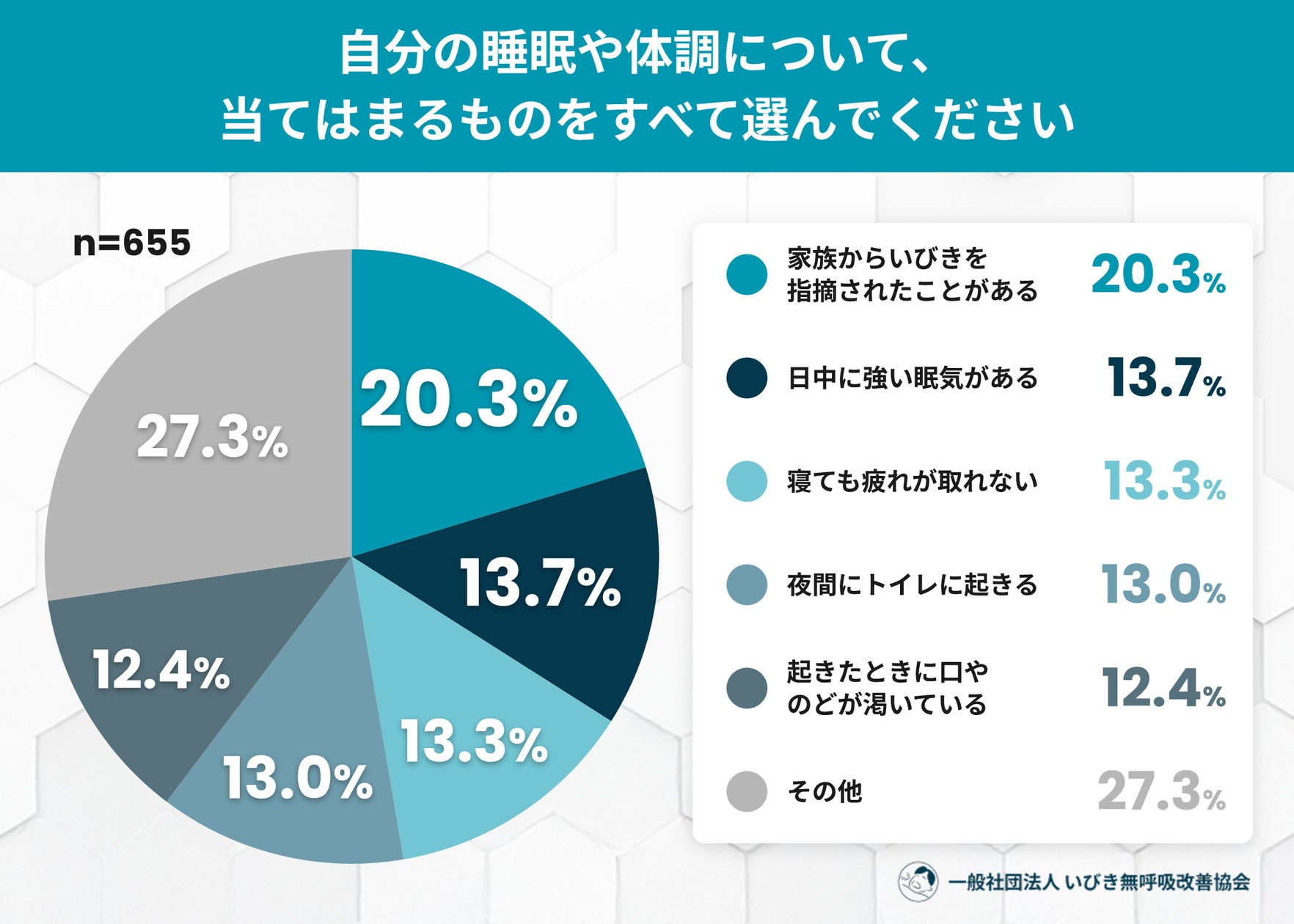
### Q1: Which of the following apply to your sleep or physical condition? (Select all that apply)
- Have been told by family that you snore: 20.3% - Strong daytime sleepiness: 13.7% - Still tired after sleeping: 13.3% - Wake up to use the bathroom at night: 13.0% - Dry mouth or throat upon waking: 12.4% - Other: 27.3% (Heavy head or fatigue in the morning: 8.7%, waking up multiple times during the night: 8.1%, high blood pressure noted during health checkup: 5.2%, etc.)
→ "Being told by family that you snore" was the most common, followed by "strong daytime sleepiness" and "still tired after sleeping," which are symptoms directly related to quality of life (QOL). This suggests that many people sense a decline in sleep quality rather than just sleep duration.
### Q2: Have you ever considered undergoing testing or consultation for sleep apnea?
- Concerned but have not yet looked into it: 42.0% - Have looked into it but have not taken further action: 21.5% - Do not think testing is necessary: 21.0% - Recommended by family but have not gone: 8.0% - Thought about going but did not make an appointment: 7.5%
→ When combining those who are "concerned but have not looked into it" and those who "have looked into it but have not taken further action," the total exceeds 60%. This highlights that many people are stuck just before taking action.
### Q3: What are the reasons for not undergoing testing or consultation?
- I think my symptoms are not severe: 19.6% - I don't know how much it costs: 17.2% - I don't have time: 14.6% - The testing process is troublesome: 13.5% - I don't know which department to visit: 11.7% - Other: 23.4% (No symptoms felt despite being told: 5.9%, not confident I can continue treatment: 5.4%, no particular reason: 5.0%, etc.)
→ After "I think my symptoms are not severe," the next most common reasons were "I don't know the cost" and "I don't know which department to visit," indicating a lack of information. Among the "Other" responses, there were also misconceptions such as "I think hospitalization is required," highlighting the need for disseminating accurate knowledge to encourage medical consultation.
### Q4: What measures have you taken on your own?
- Looked up symptoms on the internet: 26.0% - Started sleeping on my side: 22.3% - Became conscious of my weight: 12.9% - Have not done anything in particular: 10.3% - Reduced alcohol consumption: 6.3% - Other: 22.2% (Recorded with a snoring measurement app: 5.4%, asked family to check my sleeping condition: 5.4%, consulted during a health checkup: 2.6%, etc.)
→ Instead of visiting a medical institution, people tend to rely on easy information gathering such as "searching the internet" or self-contained measures like "sleeping on my side" or "being conscious of my weight."
### Q5: What do you know about sleep apnea syndrome?
- Daytime sleepiness increases the risk of accidents: 15.9% - There are outpatient clinics specializing in sleep: 13.7% - There is a treatment called CPAP: 13.0% - If left untreated, the risk of hypertension and cardiovascular disease increases: 12.8% - It can occur even in thin people: 12.1% - Other: 32.5% (There is a treatment using a mouthpiece made at the dentist: 8.8%, can consult at respiratory medicine or otolaryngology departments: 7.9%, health insurance may cover testing and treatment: 5.7%, etc.)
→ While there is a certain level of awareness about accident risk and complications, knowledge about specific information that lowers the barrier to testing and treatment—such as the existence of home sleep tests or that health insurance may be applicable—appears to be low.
Summary of Survey Results
This survey revealed that over 40% of people who are aware of sleep apnea or snoring are "concerned but have not looked into it." What prevents them from seeking medical care is not just "lack of time" or "troublesomeness." Specific "lack of information" about accessing medical institutions—such as "I don't know the cost," "I don't know which department to visit," or "I mistakenly believe hospitalization is required"—is a major barrier. To connect people to appropriate testing and treatment, it is necessary not only to emphasize the dangers of the condition but also to provide concrete and accurate information that lowers the barrier to consultation, such as "you can first consult at a nearby clinic" and "home sleep tests are also possible."
Comment from the Japan Snoring and Apnea Improvement Association
"Many people who are told they 'stop breathing during sleep' or who feel strong daytime sleepiness do not visit medical institutions. This survey highlights that behind this are misconceptions such as 'testing is large-scale, expensive, and requires hospitalization' and confusion about which department to consult. Rather than attributing the failure to seek care to individual awareness, the issue is that information is not being properly disseminated.
Currently, at home
FACT BOX
- Source: PR TIMES
- Category: Survey