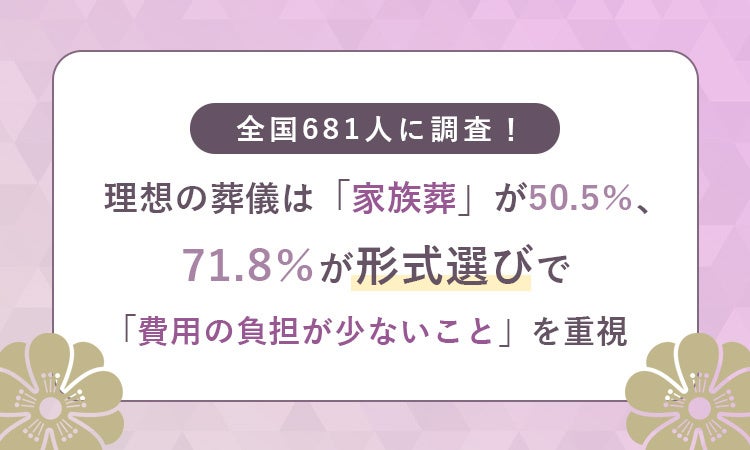
Survey on Ideal Funeral Preferences
Funerals come in various formats such as family funerals, public funerals, and direct cremations, with differing views on the number of attendees, venue, and costs. Since it's a moment to bid farewell to a loved one, deciding "what kind of time to create" and "what information would bring peace of mind" are crucial aspects.
In recent years, the range of funeral options has expanded. Beyond adhering to fixed formats, families can now choose the scale and content based on the deceased’s and family’s wishes. So, what kind of funeral is actually considered ideal?
In this survey, conducted jointly with the Yao City Funeral Service Comparison Guide Management Office, we gathered responses from 681 men and women across Japan regarding their "ideal funeral."
※ When quoting this press release, please observe the following: ・ Clearly state the source as "a survey conducted by NEXER Group Inc. and the Yao City Funeral Service Comparison Guide Management Office." ・ Include a link to the Yao City Funeral Service Comparison Guide Management Office (https://yaoshi-sougi.com/).
Survey Overview: "Ideal Funeral" Questionnaire Survey Method: Online questionnaire Survey Period: July 31, 2026 – August 10, 2026 Respondents: Men and women across Japan Valid Responses: 681 samples Survey Questions: Question 1: What funeral format do you consider ideal? Question 2: What size (number of attendees) do you prefer for your ideal funeral? Question 3: What factors do you prioritize when choosing a funeral format? (Multiple selections allowed) Question 4: What type of venue do you consider ideal for holding a funeral? Question 5: What elements make you feel "at ease" during a funeral? (Multiple selections allowed) Question 6: How necessary do you think "pre-consultation" is when preparing for a funeral? Question 7: What information would you like to know during pre-consultation? (Multiple selections allowed) Question 8: If you have any ideals or preferences regarding how you'd like your funeral to be, please share them. * Percentages are rounded to the second decimal place, so totals may not sum to 100%.
50.5% Choose 'Family Funeral (Centered on Relatives and Close Family)' as Their Ideal Funeral Format
First, we asked about the ideal funeral format.
The most common response was 'Family Funeral (Centered on Relatives and Close Family)' at 50.5%.
This was followed by 'No particular preference' at 23.3%, and 'Direct Cremation (Cremation only)' at 15.7%. 'Public Funeral (Friends and acquaintances attend)' accounted for 4.4%, and 'One-Day Funeral (No wake)' for 5.6%.
Over half prefer a family funeral, showing a significant difference from public funerals that broadly invite friends and acquaintances. However, it's also notable that over 20% have 'no particular preference.' This suggests that a certain number of people prefer to make decisions based on family structure, the deceased’s wishes, and costs at the time, rather than deciding on a funeral name or format in advance.
Although 'family funeral' and 'direct cremation' differ in content, both formats allow for limiting attendees and rituals. Given that many respondents later expressed a preference for smaller-scale funerals, there is a clear tendency toward desiring funerals with limited attendees and scale.
54.3% Prefer an Ideal Funeral Size of 'Under 10 Attendees'
Next, we asked about the ideal scale (number of attendees) of a funeral.
'Under 10 attendees' was the most common response at 54.3%, followed by '10 to under 30 attendees' at 21.7%.
Meanwhile, 'Unsure' accounted for 18.1%. '30 to under 50 attendees' was 3.8%, while '50 to under 100 attendees' and '100 or more attendees' each stood at 1.0%.
Combining 'under 10' and '10 to under 30' gives 76.0%, meaning over three out of four people prefer a funeral with fewer than 30 attendees. This aligns with the earlier result where 50.5% chose 'family funeral,' indicating a clear preference for smaller-scale funerals.
Smaller funerals allow more time to interact with each attendee and make it easier to limit preparations such as venue and catering. On the other hand, deciding who to invite is necessary. The 18.1% who answered 'unsure' suggests the difficulty in concretely determining the number of attendees in advance.
The key point is not simply reducing the number of people. It's about who you want to spend time with and what kind of moment you wish to create. The appropriate scale should be determined based on this, serving as one criterion for choosing a funeral.
71.8% Prioritize 'Low Financial Burden' When Choosing a Funeral Format
Next, we asked about the factors respondents prioritize when choosing a funeral format (multiple selections allowed).
'Low financial burden' was the top response at 71.8%, followed by 'clear pricing structure' at 41.0%, 'trustworthy funeral service provider' at 28.8%, and 'ease of preparation and procedures' at 27.5%.
In addition to 'low financial burden' being the most important factor, 'clear pricing structure' ranked second, indicating that people value not only the total cost but also pricing transparency. Funeral packages may have additional costs depending on the number of attendees and services. Therefore, both the total amount and pricing clarity are important decision-making factors.
Meanwhile, 'ability to reflect the deceased’s personality' was selected by 24.2%, 'consideration for attendees (accessibility and burden)' by 24.4%, and 'staff’s attentive service' by 24.5%—each chosen by about one in four respondents. Although cost is the top priority, it's clear that people do not base their decision solely on cost.
There is a visible trend of wanting to balance multiple factors—such as reflecting the deceased’s character, consideration for attendees, and service quality—alongside cost when making a choice.
46.8% Prefer 'Funeral Hall or Venue' as the Ideal Location
Next, we asked about the ideal location for holding a funeral.
'Funeral hall or venue' was the most preferred option at 46.8%, followed by 'no particular preference' at 26.7%, 'facility attached to crematorium' at 15.4%, 'private home' at 9.1%, and 'temple' at 1.9%.
While many prefer smaller-scale funerals, 'funeral hall or venue' emerged as the top choice for location.
Additionally, over one in four respondents had 'no particular preference,' suggesting that a significant number of people do not have strong preferences for the venue itself and prefer to choose flexibly based on circumstances.
The ideal venue cannot be determined by location alone. Priorities vary based on attendee composition—such as travel distance for elderly attendees or venue size for small gatherings. Considering logistics on the day, beyond just the format, appears essential for practical venue selection.
74.3% Feel 'At Ease' When the Total Cost Is Clearly Stated in Advance
Next, we asked about the elements that make people feel 'at ease' during a funeral (multiple selections allowed).
The top response was 'clear total cost stated in advance' at 74.3%, followed by 'staff providing detailed explanations' at 45.8%, '24-hour support availability' at 25.1%, and 'positive reviews and reputation' at 21.1%.
Again, 'clarity of total cost' stood out. When choosing a format, 71.8% prioritized 'low financial burden' and 41.0% valued a 'clear pricing structure,' confirming across multiple questions the high importance placed on cost-related factors.
FACT BOX
- Source: PR TIMES
- Category: Survey結果