Details and registration here
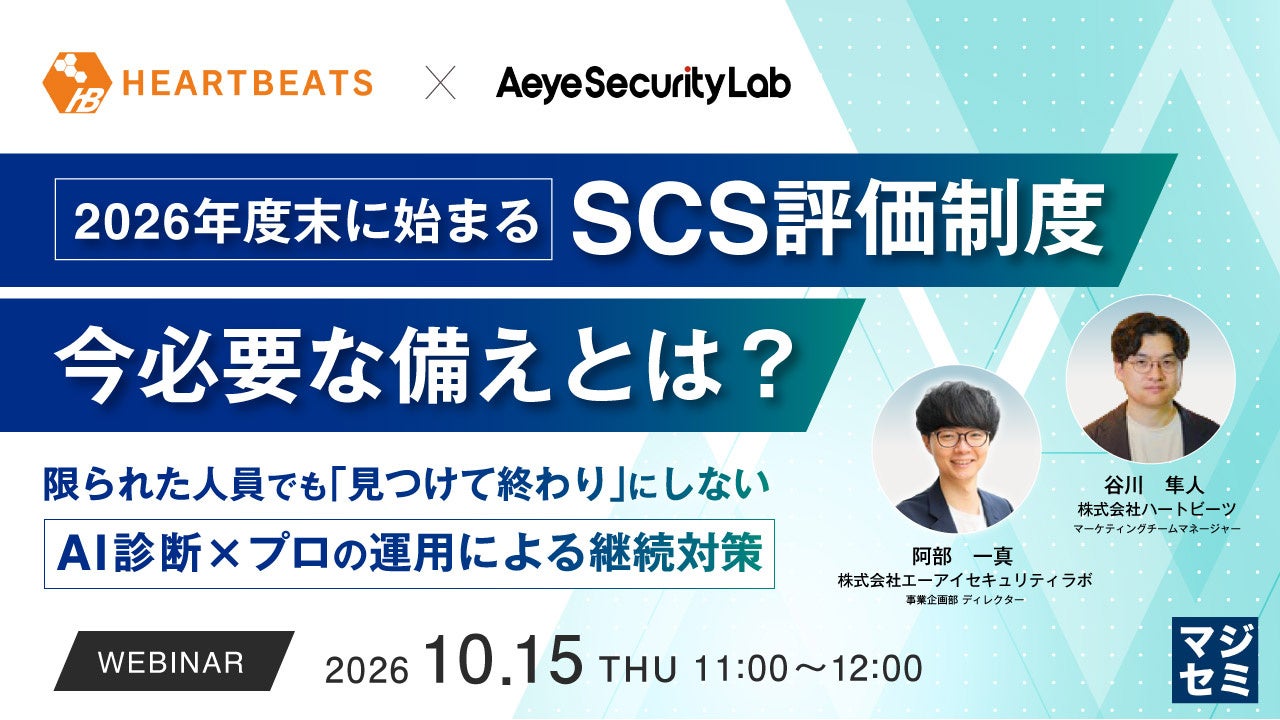
Moving from 'one-time measures' to 'continuous compliance' *This seminar refers to the 'Security Measures Evaluation System for Supply Chain Strengthening (SCS Evaluation System)' promoted by METI.
An increasing number of companies are being asked by business partners to explain their security measures or to respond to stricter security checklists. Against this backdrop, there is a growing need to establish a system that continuously identifies and remediates vulnerabilities across the entire supply chain, not just within one's own company, and to keep evidence of actions taken.
In this context, METI is considering the 'Security Measures Evaluation System for Supply Chain Strengthening (SCS Evaluation System)' aimed at improving security levels across the supply chain. For ★3 and ★4, certification applications are expected to begin around the end of FY2026. Whether a company obtains certification may become a transaction criterion, and responding to the security levels demanded by business partners is expected to become even more important. Among these, continuous response to known vulnerabilities is crucial. There is still time to prepare before the system begins.
Even companies that have conducted 'annual vulnerability diagnostics' may not find this sufficient. The SCS evaluation system requires continuous identification of vulnerabilities, remediation based on risk, and keeping evidence of actions. Stopping at the traditional 'annual diagnosis' becomes a practical barrier.
From 'Did we conduct a diagnosis?' to 'Are we continuously addressing discovered vulnerabilities?' With the SCS evaluation system in mind, it is necessary to rethink vulnerability management itself.
With limited staff, it is difficult to manage both 'diagnosis' and 'post-discovery' processes However, when trying to achieve continuous vulnerability management, many companies face barriers of staffing and expertise. Simply identifying assets to be diagnosed and conducting regular diagnostics requires specialized knowledge and significant effort. Furthermore, when vulnerabilities are found, it is necessary to determine whether to respond, prioritize, implement actual remediation, and continuously monitor the situation thereafter.
Especially in environments where security tasks are handled by limited staff: - Lack of personnel and expertise to continue diagnostics - Concerns about quality and operational structure even if internalizing diagnostics - Inability to determine response necessity or priority even when vulnerabilities are found - Daily operations take precedence, delaying responses to discovered vulnerabilities
Moreover, the problem is not just 'inability to diagnose' but also 'inability to follow through after diagnosis.' Many companies face the issue of discovering vulnerabilities but leaving them unaddressed due to lack of resources or decision criteria. How to continue this series of vulnerability management with limited staff while meeting the security levels demanded by business partners is a major challenge.
From 'finding' to 'not leaving unaddressed' through AI-based diagnostic internalization and professional operational support This seminar will explain vulnerability management that does not end with 'annual diagnosis' from two perspectives: diagnosis and subsequent operations, with the SCS evaluation system in mind.
In the first half, AI Security Lab Inc. will introduce how to utilize AI to internalize vulnerability diagnostics, enabling continuous diagnosis even with limited staff. In the second half, Heartbeats Inc. will introduce approaches to connect post-discovery judgment and remediation to continuous operations, rather than ending with finding vulnerabilities.
'Continuously finding' and 'not leaving unaddressed after discovery.' We will provide hints for continuing vulnerability management with limited resources while preparing for the SCS evaluation system.
・ Recommended for those in these positions / facing these challenges ・ Being asked by business partners to explain security measures based on the SCS evaluation system ・ Unable to meet monitoring and security requirements demanded by business partners with limited staff alone ・ Conducting vulnerability diagnostics but not continuously managing post-diagnosis judgment and remediation ・ Feeling anxious about whether current vulnerability management is sufficient for SCS compliance
・ What you can take away from this seminar What is important for SCS compliance is not just diagnosing vulnerabilities once, but creating a state where you continuously identify and address discovered vulnerabilities. This seminar will consider sustainable vulnerability management approaches from two angles: AI-based diagnostic internalization and operational support that does not leave discovered vulnerabilities unaddressed.
What kind of diagnostic and operational structure is needed beyond 'annual diagnosis'? If you are looking to review your vulnerability management in light of security measures demanded by business partners or the SCS evaluation system, please join us.
Organizers and Co-organizers Heartbeats Inc. AI Security Lab Inc.
Cooperation Majisemi Inc.
Details and registration here
Majisemi will continue to host webinars that are 'useful to participants.'
Past seminar materials and other open seminars are available here ▶
Majisemi Inc.
〒102-0094 Tokyo, Chiyoda-ku, Kioicho 3-12 Contact: https://majisemi.com/service/contact/
FACT BOX
- Source: PR TIMES
- Category: Event