After the autumn equinox, the sun rises later each day, marking the fall-winter season. As temperatures drop, more people complain of difficulty waking up and feeling sluggish during the day. Moon Moon Inc., which operates the sleep product review site "Kaimin Land," conducted a survey on "Reduced Daylight and Morning Wakefulness" targeting 200 men and women in their 20s to 60s nationwide. The results show that about 40% find it harder to wake up compared to summer, but only about 10% attribute this difficulty to the seasonal reduction in daylight. The close relationship between the human body clock and light highlights the hidden factor of "light deficiency" in autumn morning wakefulness issues.
Survey Background
Springtime drowsiness and May blues are well-known sleep issues, but the difficulty of waking after the autumn equinox is also strongly linked to scientific seasonal factors. As sunrise becomes later, the amount of light received upon waking drops sharply, making it harder for the body clock to reset. However, many people attribute this change to "lack of self-discipline," "age," or "cold weather." This survey aimed to clarify the autumn-specific changes in sleep and waking, and the gap between people's awareness and behavior regarding morning light, to promote proper waking habits adapted to seasonal changes.
Survey Summary
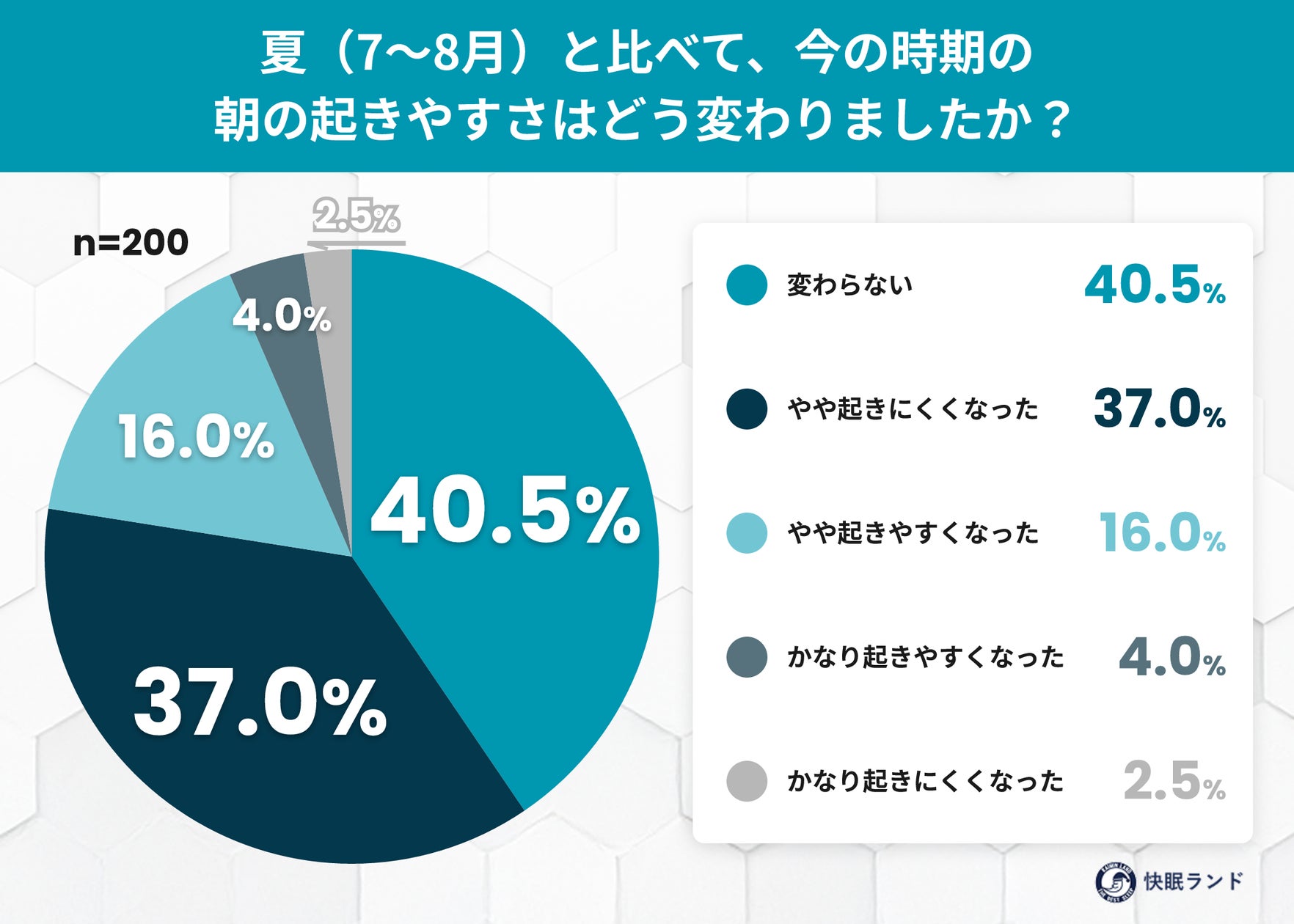
About 40% (39.5%) feel it is "harder to wake up" in the morning compared to summer.
Top autumn sleep changes include "it takes time to get out of bed" and "sleep duration has increased."
The most cited cause of difficulty waking is "because it's cold and the futon feels comfortable" (20.4%). Only 10.5% cite "because sunrise is later."
While 32.0% know that "morning light resets the body clock," over half (53.5%) do not get enough light within one hour of waking (less than 5 minutes or none at all).
* When citing these survey results, please include the URL of "Kaimin Land" (https://intiinti.com/goodsleep/).
Detailed Data
Q1. Compared to summer (July-August), how has your ease of waking changed now?
No change: 40.5%
Somewhat harder: 37.0%
Somewhat easier: 16.0%
Much easier: 4.0%
Much harder: 2.5%
→ Combining "somewhat harder" and "much harder," about 40% (39.5%) find it more difficult to wake up than in summer. The seasonal transition to autumn is manifesting as a clear physical change.
Q2. What changes have you noticed in your sleep in autumn?
It takes time to get out of bed: 20.4%
No particular change: 16.6%
Sleep duration has increased: 16.6%
Strong daytime sleepiness: 13.7%
Strong sleepiness in the evening: 7.0%
Other: 25.7% (can't wake even when alarm rings: 7.0%, difficulty falling asleep: 6.4%, lighter sleep: 6.1%, etc.)
→ The most common response is "it takes time to get out of bed," followed by "sleep duration has increased," clearly showing autumn-specific behavioral changes like "can't wake up refreshed" and "oversleeping."
Q3. What do you think causes the difficulty waking in autumn mornings?
Because it's cold and the futon feels comfortable: 20.4%
I don't feel particularly hard to wake: 14.6%
Because I'm tired: 10.8%
Because I stay up late: 10.8%
Because sunrise is later: 10.5%
Other: 32.9% (irregular bedtime: 9.7%, bedroom is dark and no morning light: 7.7%, I think it's age: 6.4%, etc.)
→ Many attribute the difficulty to "temperature," "fatigue," or "self-management (staying up late)." Only about 10% (10.5%) recognize the environmental factor of "later sunrise (reduced light)," indicating low awareness of biological seasonal effects.
Q4. How much outdoor light do you get within one hour of waking?
Less than 5 minutes: 28.0%
None at all: 25.5%
5-15 minutes: 21.5%
Varies greatly by day: 15.5%
30 minutes or more: 7.0%
16-30 minutes: 2.5%
→ Over half (53.5%) answered "none at all" or "less than 5 minutes" of outdoor light immediately after waking. This reveals that ensuring adequate morning sunlight is physically challenging for modern people due to commuting and living environments.
Q5. What do you know about the benefits of morning light?
It resets the body clock: 32.0%
It is related to mood: 16.8%
It affects falling asleep at night: 11.7%
It is best to get it within one hour of waking: 7.9%
Ordinary indoor lighting is insufficient: 7.1%
Other: 24.5% (outdoors is much brighter than indoors even on cloudy days: 6.8%, autumn/winter have shorter daylight and are more affected: 6.2%, there is a recommended duration: 5.3%, etc.)
→ About 30% are aware of the body clock resetting effect of light, showing a certain level of knowledge. However, compared with the behavioral results in Q4, there is a significant gap between "knowing" and "doing."
Summary of Survey Results
This survey revealed that many people suffer from difficulty waking after the autumn equinox, but few link it to reduced light (later sunrise). The human body stops secreting the sleep hormone (melatonin) when exposed to bright morning light, switching to active mode. Even though many know that "light resets the body clock," over half do not get enough light immediately after waking. Therefore, it is important to review the light environment before blaming temperature or fatigue. To get through the autumn-winter season healthily, it is essential to scientifically understand the lack of daylight due to seasonal changes and adopt waking habits that effectively use light.
Comment from Kaimin Land Operator
Comment by Koichi Takeda, Operator
From autumn to winter, more people fall into self-loathing because they "can't wake up" or "feel sluggish during the day," but this is not due to weak willpower; it is caused by disruption of the biological rhythm due to reduced daylight. As this survey shows, many attribute it to temperature or fatigue, but "bright morning light" is essential for a fundamental solution. However, even if you open the curtains immediately after waking, depending on weather and orientation, you may only get light equivalent to indoor lighting. If you cannot get natural light, using technology such as "dawn simulator alarm clocks" that emit bright light at a set time can effectively create a light environment similar to a summer morning.
Survey Overview
Survey period: September 26-27, 2026
Target: 200 men and women in their 20s to 60s nationwide
Method: Internet survey
Conducted by: Kaimin Land (Moon Moon Inc.)
FACT BOX
- Source: PR TIMES
- Category: Survey