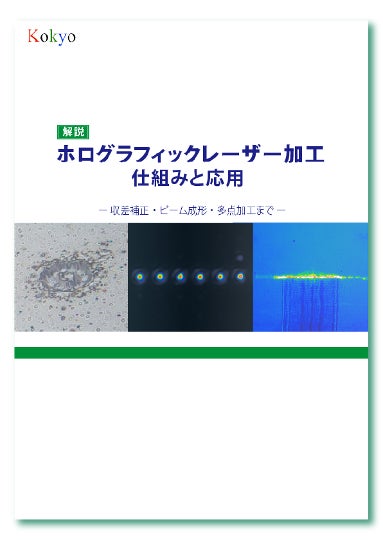
Symphotony Inc. has announced the release of a technical document explaining 'holographic laser processing,' a method that enables precise control over the shape and focal position of laser beams.
Holographic laser processing uses computer-generated holograms (CGH) displayed on a spatial light modulator (SLM) to control the phase of laser light. This allows for beam shaping, multi-point simultaneous processing, and aberration correction—capabilities difficult to achieve with conventional focusing optics. For example, a single laser beam can be split into multiple beams for parallel processing, or special irradiation patterns such as optical vortices and line beams can be generated, enhancing processing efficiency and expanding the freedom of machinable shapes. Additionally, by correcting aberrations that occur inside transparent materials, this technology enables precise focusing and internal processing at targeted locations.
This document systematically introduces fundamental knowledge of holographic laser processing, the principles of spatial light modulators (SLM), key processing technologies such as beam shaping, multi-point processing, and aberration correction, as well as application examples including internal processing of transparent materials. It is designed for customers considering adoption of this technology and for professionals in research, development, and manufacturing who utilize advanced laser processing techniques. We encourage its use for technology evaluation and deeper understanding.
Download the document here: https://www.symphotony.com/contactus/fs-technical02-sheet_form/?utm_source=prtimes&utm_medium=referral&utm_campaign=LFS_20260911
Document Overview
What is Holographic Laser Processing?
Principles of Liquid Crystal on Silicon Spatial Light Modulators (LCOS-SLM)
High-Precision Processing via Aberration Correction
Beam Shaping Technologies (e.g., Optical Vortex, Line Beam)
Improved Processing Efficiency through Multi-Point Simultaneous Processing (Beam Splitting)
Principles and Application Examples of Internal Processing in Transparent Materials
Introduction to Symphotony's Holographic Femtosecond Laser Processing System 'Femto-pro-HGS'
Sample Content
Illustrated Explanation of How Holographic Laser Processing Works
Holographic laser processing is a method that controls laser light using a 'holographic optical system.' By illuminating a computer-generated hologram displayed on a spatial light modulator with a laser, processing with arbitrary beam patterns created by a computer becomes possible. This enables higher precision and efficiency in processing without requiring complex optical setups. This document clearly explains the fundamental mechanisms of holographic laser processing using illustrations.
What Can Be Achieved with Holographic Laser Processing
Symphotony's holographic laser processing systems utilize SLM-based laser beam control to enable aberration correction, beam shaping, and multi-point processing. This document details the mechanisms and features of each processing and optical control method, supported by schematic diagrams and real processing examples.
Example 1: Aberration Correction
Example 2: Beam Shaping (Left: Optical Vortex, Right: Line Beam)
Example 3: Multi-Point Simultaneous Processing (Beam Splitting)
10-point beam profile, 5 μm distance between points
Example 4: Multi-Point Internal Processing in Transparent Materials
Related Product Symphotony's Holographic Femtosecond Laser Processing System 'Femto-pro-HGS'
Product Page: https://www.symphotony.com/products/ultrashort/femto-pro-hgs/?utm_source=prtimes&utm_medium=referral&utm_campaign=LFS_20260911
Contact
Laser Processing Division, Symphotony Inc.
Contact: Kawabata
Inquiry Form: https://www.symphotony.com/ultrashort_contact/
Tel: 080-2452-9200 (Weekdays 9:00–18:00, excluding weekends and holidays)
Email: fs-inquiry@symphotony.com
FACT BOX
- Source: PR TIMES
- Category: New Product
- Products / services: Femto-pro-HGS